

Retail leaders are operating in a market where performance is increasingly judged by what the business will become, not just what it delivers today. RDG’s Enterprise Value Model guides retail leaders to build enterprise value through revenue, positioning, & capability toward 2030.
Key Takeaways
- Enterprise value determines how retail businesses are assessed, funded, and grown.
- Revenue quality, strategic positioning, and capability directly shape valuation outcomes.
- Leadership decisions on capital allocation and strategic focus define long-term value.
- Structured strategy sessions provide the clarity required to align decisions with enterprise value.
Why the Enterprise Value Model?
Retail leaders are operating in a market where performance is increasingly judged by what the business will become, not just what it delivers today. For years, success was measured through sales growth, store expansion, and like-for-like momentum, and these indicators still track performance effectively.
While these metrics show how a business is trading, it is the structure behind that performance that determines how it will be valued. Boards, investors, and owners are now focused on a more defining question:
What is this business worth, and why?
That question brings enterprise value into focus, because it reflects how revenue is built, how resilient it is, and how confidently it can scale over time.
The Structural Shift Driving Strategy Change
Retail operating models are evolving at pace across global and Australian markets.
Customer journeys are becoming more connected, technology platforms are integrating across functions, and physical retail continues to strengthen its role as the centre of brand experience and customer engagement.
As these shifts take hold, the way value is created is also changing:
- Revenue is no longer assessed purely by volume or growth trajectory, but by its quality, repeatability, and margin profile.
- Positioning is no longer defined by category presence alone, but by how clearly a retailer occupies a meaningful space in the customer’s mind.
- Capability is no longer an operational support function, but a determinant of how effectively strategy is executed at scale.
Together, these shifts create a new structure for retail competition, where enterprise value becomes the scoreboard for leadership performance.
The Enterprise Value Model
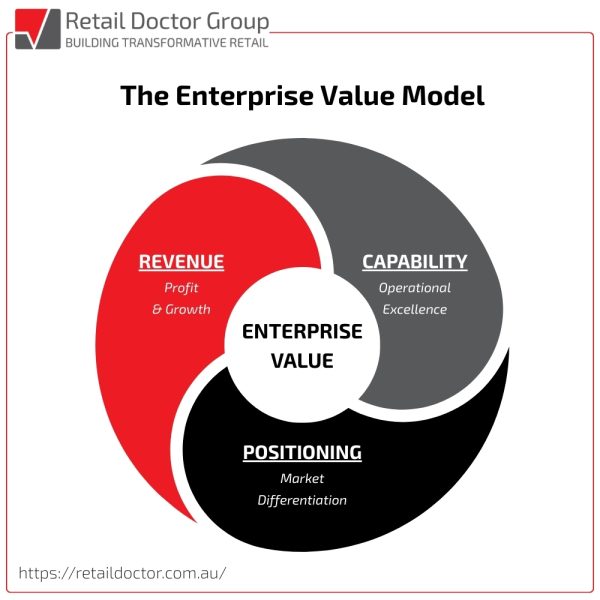
The Enterprise Value Model defines how retail value is built through these three connected levers.
Revenue
Revenue reflects how the business generates income, but more importantly, how that income holds over time.
Profitability, growth consistency, and margin discipline determine whether revenue contributes to long-term value or short-term performance.
High-quality revenue is typically characterised by strong margin structure, repeat customer behaviour, and reduced reliance on discounting to drive volume.
Positioning
Positioning defines how the business competes and how clearly it is understood by the market.
Retailers with strong positioning establish a clear value proposition that customers recognise and return to. This clarity strengthens pricing power, reduces reliance on promotion, and builds brand authority.
Positioning also influences how the business is perceived by investors, particularly in terms of defensibility and long-term relevance.
Capability
Capability determines how effectively the business can deliver on its strategy.
Operational excellence, data capability, AI integration, and leadership alignment all contribute to execution quality.
While retailers may define strong strategies, it is capability that determines whether those strategies translate into consistent outcomes.
While retailers have access to all three levers, it is how they are applied in daily decisions that determines long-term value.
The Enterprise Value Model in Practice
Applying the Enterprise Value Model requires a clear and repeatable sequence that leadership teams can follow consistently.
Retail Doctor Group structures this through a defined engagement pathway that ensures strategy moves beyond discussion and into execution.
- Define the 2030 enterprise value ambition, establishing a clear view of how the business should be valued in the future
- Assess current performance across revenue, positioning, and capability to understand the starting point
- Identify structural gaps that influence valuation, including margin pressure, positioning clarity, and capability constraints
- Align leadership priorities across capital allocation, operating focus, and capability investment
- Translate those priorities into a practical execution pathway that can be implemented across the organisation
This sequence creates consistency across engagements and ensures strategy is developed, aligned, and executed through the same disciplined Enterprise Value Model each time.
Why This Matters
Two retail businesses can deliver similar financial results and still be valued very differently.
The difference sits in how revenue is structured, how clearly the brand is positioned, and how effectively capability supports execution.
A business with strong revenue quality, clear positioning, and aligned capability presents a more stable and scalable earnings profile, which attracts stronger valuation multiples.
Conversely, businesses that rely on inconsistent revenue, unclear positioning, or fragmented capability often experience pressure on both performance and valuation.
Enterprise value therefore becomes a direct outcome of leadership decisions, rather than a by-product of trading performance.
ESSENTIAL READING:
Building Value Through Structured Strategy
Retail leaders benefit from stepping into a structured environment where these decisions can be made with clarity.
In these sessions, leadership teams use the Enterprise Value Model to work through how future revenue will be generated and sustained, and how margin and cost discipline will evolve over time.
They also define how customer ownership strengthens competitive position, and how capability investment supports long-term value creation.
This process connects strategic intent to operational reality, ensuring that decisions made at leadership level translate into measurable outcomes across the business.
Next Steps for Retail Leaders
Retail leaders looking to build enterprise value benefit from structured strategy sessions that align leadership, clarify priorities, and connect decisions to long-term outcomes.
Retail Doctor Group works with Boards and executive teams to assess current position, define future value ambition, and establish a clear roadmap toward Retail 2030.
Let’s talk.
Authored by:
Brian Walker
#AustralianRetail #Benchmarks #BrianWalker #BusinessAgility #BusinessGrowth #BusinessPerformance #BusinessTransformation #DataDrivenRetail #Ebeltoft #FitForBusiness #FutureOfRetail #FutureRetail #Innovation #Leadership #LimbicRetail #RDG #RDGInsights #RetailDoctorGroup #RetailExcellence #RetailInnovation #RetailLeadership #RetailManagement #RetailStrategy #RetailTransformation #StrategicReview #Strategy #StrategyWorkshop #SustainableRetail