
Net retention rate is the commercial test of whether loyalty is being rented or earned, and answers the commercial version of the loyalty question: After we’ve acquired a consumer, do they keep choosing us, keep spending with us, and create more value over time?
RDG’s Paradox of Customer Loyalty executive brief reveals why loyalty program participation can rent behaviour, and how retailers can use emotional loyalty, brand experience, and RDG’s Limbic Insights™ to turn rented loyalty into preferred choice.
Key Takeaways
- Loyalty operates across three distinct drivers: transactional, behavioural, and emotional.
- Retail loyalty programs influence participation, choice, timing, and frequency, but activity alone does not equal commitment.
- The vast majority of Australians belong to at least one loyalty program, yet half of them would switch for a better offer elsewhere.
- Brand and in-store experience are stronger stated drivers of loyalty than program membership, positioning loyalty programs as part of a wider brand and experience system rather than the primary source of preference.
- RDG Limbic Insights™ identifies what priority consumers need to feel before they choose, stay, and return, turning loyalty activity into preference that can survive a better offer – and be measured consistently.
ICYMI: WATCH THE WEBINAR REPLAY
What is Loyalty’s Net Retention Rate?
In simple terms, net retention rate measures how much value a retailer keeps from existing consumers after churn, reduced spend, switching, and increased spend are all taken into account. It helps reveal whether existing consumers are still commercially valuable after the cost of acquisition, rewards, discounts, offers, and incentives.
Net retention rate is useful in a loyalty conversation because it cuts through vanity metrics. A retailer can have a huge member database, high enrolment, strong redemptions, and even more program activity than usual, and yet still lose consumer value if people only stay while the deal seems worth it.
Loyalty Participation Is Reach, Not Preference
Retailers have become skilled at acquiring members. The next loyalty challenge is proving that those members prefer the brand, use the program, return with intent, and stay when a rival improves the offer.
RDG’s The Paradox of Customer Loyalty executive briefing, used in the recent webinar, defines the commercial tension. Half of a brand’s loyal customers aren’t loyal at all, and would switch to another similar brand if its loyalty program offered better value or benefits. So, participation is widespread. Commitment is not.
That creates a practical challenge for every retail CEO, CMO, loyalty leader, and customer team. A program can grow its member base, lift usage, and increase interaction, while still leaving preference exposed. The database may be expanding, the dashboards may show activity, and the promotional engine may be working, yet the consumer may still be choosing the deal rather than the brand.
That is rented retention. It holds the consumer hostage while the exchange is strongest, most visible, or most convenient. It can be valuable, but it has to be recognised for what it is: a behavioural response that needs to be converted into preferred choice.
The webinar and executive brief give retailers a more useful way to assess loyalty program strategy. It’s not about how many consumers have joined. It’s about how many have stayed, and whether they would still choose your brand if a competitor offered something of more perceived value.
The Paradox Of Customer Loyalty
The paradox of customer loyalty is that program activity can rise while loyalty remains vulnerable. RDG’s research shows 35% of consumers are using loyalty programs more often than six months ago, 54% are using them at the same level, and 11% are using them less.
But activity is just a signal. It’s not the final proof.
Consumers can use a program because it’s useful, the rewards are visible, the retailer is convenient, or the experience forms part of a routine. If fragile loyalty is your basis for the numbers, those are still commercially useful behaviours that shape visits, timing, frequency, and sometimes category choice.
Preferred choice asks for more. It asks whether the brand, the experience, the value exchange, and the emotional connection are strong enough for the consumer to stay when a rival becomes cheaper, easier, faster, or more rewarding.
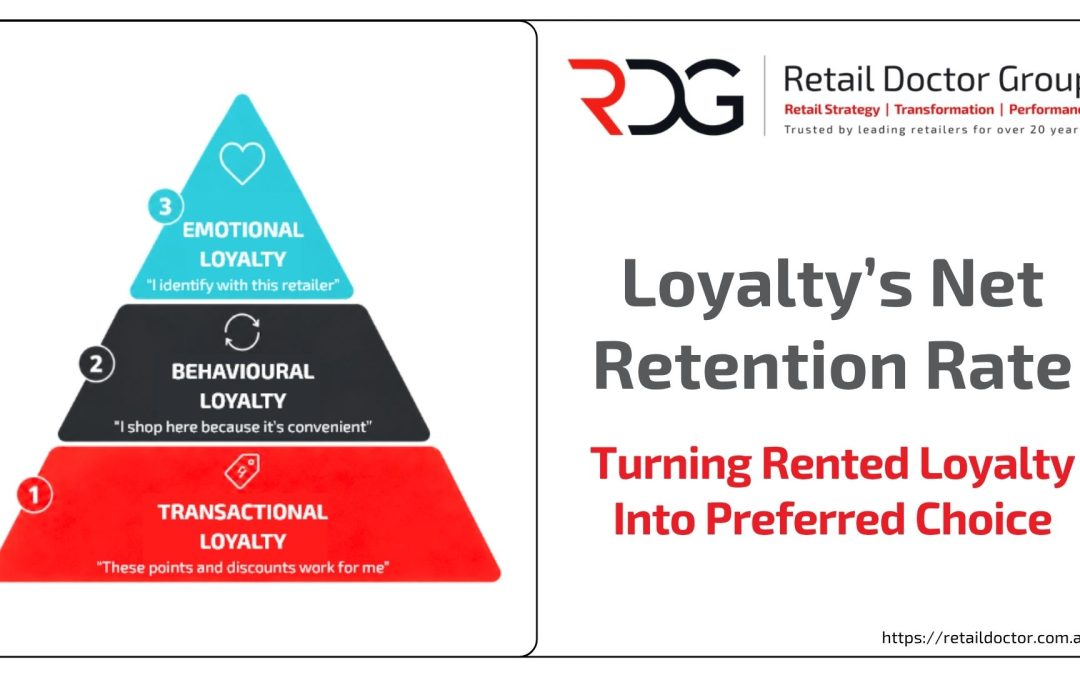
RDG’s executive brief frames loyalty as a hierarchy across three levels:
- transactional (price, points, rewards)
- behavioural (convenience and habit)
- emotional (trust, identity, belonging)
Each has value. Each carries a different risk. Each needs to be measured differently.
Transactional Loyalty: The Deal That Wins Today
Loyalty programs are often judged first on functional clarity. Transactional loyalty is driven by price, points, discounts, rewards, and visible savings. It says, “I’m here because the value makes sense.”
Consumers respond when they can see what they get, how they earn it, and how they use it, most often describing loyalty programs through rewards and freebies at 52%, followed by discounts and added value at 33%. This transactional exchange is the most visible layer of loyalty.
Transactional loyalty is easy to activate and easy to trade. Price, points, and offers can prompt participation, yet the same mechanics can be matched by another retailer. The consumer can move quickly when a competitor presents a stronger value exchange.
Transactional loyalty creates participation before preference. It gets consumers through the door, into the database, and into the program experience. That’s a useful starting point, but it rarely carries the full weight of retention. Once a competing offer improves, the retailer needs something stronger than the immediate deal.
Retailers should still get the transactional layer right. Visible value and clear rewards still matter. Easy earning, easy redemption, and credible benefit design matter, too. The discipline is to treat transactional loyalty as the start of the loyalty journey, not the destination.
Behavioural Loyalty: The Routine That Builds Momentum
Behavioural loyalty is driven by convenience, habit, ease, routine, reduced friction, and shopping familiarity. It says, “I shop there because it’s easy, familiar, and useful.”
Behavioural loyalty shows movement. It demonstrates that the program is influencing what consumers do. These types of loyalty programs are effective at influencing retailer choice, shopping timing, and visit frequency, with 80% of consumers influenced in some way by retail loyalty programs. It makes a strong case for treating programs as a behavioural lever.
Routine can create commercial momentum. Consumers may choose the retailer more often, check offers before shopping, use apps in-store, redeem rewards, and plan purchases around member value. These behaviours make the program part of the shopping rhythm, which can improve engagement and reduce friction.
But behavioural loyalty has to be pressure-tested. A routine can be disrupted. A convenient program can lose ground to a better-designed one. A retailer that tracks activity without testing resilience may confuse program influence with commitment. High program influence can still coexist with fragile loyalty.
Retail loyalty programs need a more disciplined measurement model. The goal is not only to know whether the program changes behaviour, but whether that changed behaviour survives a better offer.
A consumer who shops more often because the program is useful is valuable. A consumer who continues choosing the retailer when a competitor improves its offer is more valuable.
So, behavioural loyalty gives retailers the middle layer, but the path to preferred choice still requires emotional relevance.
Emotional Loyalty: The Preference That Survives Pressure
Emotional loyalty is driven by trust, recognition, relevance, identity, belonging, confidence, care, and emotional fit. It says, “I choose this retailer because it feels right for me.”
Emotional loyalty is the highest-value form of loyalty. It is the level that turns program participation into preferred choice because the consumer feels a stronger connection to the brand, the experience, and the reason to return. It’s harder to build, harder to copy, and stronger to defend.
Brand and experience create the reason to choose. RDG’s research shows brand look and feel at 55%, and in-store experience at 38%, are stronger stated reasons for loyalty than program membership at 32% or lowest price at 28%. This clearly identifies emotional loyalty as a reinforcement mechanism within a broader loyalty system, not the sole reason a consumer chooses the brand.
Emotional loyalty requires a deeper understanding of what consumers need to feel. RDG Limbic Insights™ identifies the emotional drivers behind choice, staying, switching, and returning. It recognises that the same mechanic can land differently across consumer mindsets. A clear savings message may create control for one consumer, progress for another, reassurance for another, and indifference for another.
Loyalty strategies now become more commercial and more precise. A retailer can design rewards, communications, experiences, and service standards around the emotional reasons priority consumers are most likely to stay.
The outcome is a program that does more than trigger usage. It supports a reason to prefer the retailer.
From Incentivised To Committed Consumers
The RDG loyalty matrix gives retailers a useful operating lens:
- Enrolled consumers have joined, but the program changes little.
- Incentivised consumers respond to the program, but remain vulnerable to a stronger offer.
- Preferred consumers choose the brand, even when program influence is limited.
Committed consumers show the strongest position: the program changes behaviour, and consumers remain resilient when competitors offer more.
Most retail loyalty programs are designed to move consumers from enrolled to incentivised. They can encourage usage, redemption, and interaction.
The next commercial step is harder – and more valuable. It requires the retailer to build preference and resilience through brand, experience, emotional relevance, and trust.
RDG’s executive brief’s insight is simple and commercially uncomfortable: programs can buy behaviour, while emotional distinction builds loyalty that stays.
That does not weaken the role of loyalty programs. It strengthens the expectation placed on them.
A program has to connect visible value with a reason to prefer the brand. It has to move beyond participation mechanics and support the emotional promise the retailer wants to own.
THIIRST CAMEL: RDG’S INSIGHTS-DRIVEN LOYALTY RETENTION CASE STUDY
How RDG’s Limbic Insights™ Changes Loyalty Execution
RDG’s Limbic Insights™ turns the emotional reason to stay into a loyalty operating plan. It starts by identifying which consumer segments matter most to growth and profitability. It then defines what those consumers need to feel, translates that emotional ground into program design and experience, embeds it across the business, and measures whether preference and resilience are improving.
That approach changes six practical areas of loyalty execution:
- Program design becomes less about universal mechanics and more about mechanics that earn preference.
- Rewards and value become easier to understand before they can become emotional.
- Recognition and communications frame the same benefit to different emotional triggers.
- Store and digital experience invest in the look, feel, and ease that shape the choice.
- Experience and people help teams recognise whether consumers need proof, fairness, progress, care, flexibility, or reassurance.
- Measurement and investment identify which emotional needs are under-served, and where growth can come from.
That’s the shift from loyalty administration to loyalty strategy. The program still has to work at a functional level, but its commercial value increases when it becomes part of the brand’s preferred-choice system.
Three Commercial Questions For Retail Leaders
These are the three questions every retail CEO should be able to answer:
- Who stays because they like your brand, and who stays for the deal?
- What would keep your consumers with you if a rival offered more?
- Does your program have a positive ROI?
These questions move loyalty beyond membership and redemption. They ask whether the program is reducing preventable churn, improving customer acquisition payback, protecting margin, and growing lifetime value. They also ask whether the business can separate active consumers from genuinely committed customers.
That separation is essential. A large member base can look powerful while hiding weak preference. A high activation rate can look healthy while masking switchability. A strong promotional response can look like loyalty while relying heavily on reward cost.
The opportunity is to see the loyalty the business really has, make the value easy to use, give consumers a reason to prefer the retailer, and then test whether the relationship holds when the reward is matched.
Next Steps for Retail Leaders
Rented retention has a role in retail. It can bring consumers closer, keep the program active, and create behavioural momentum. The commercial risk appears when rented behaviour is mistaken for resilient loyalty.
Preferred choice is built differently. It depends on functional ease, visible value, credible rewards, brand strength, experience quality, emotional relevance, and trust. It requires the retailer to know which consumers are worth winning and keeping, what they need to feel, and what the business must deliver consistently to earn that choice.
Loyalty program participation is the beginning of the commercial conversation. The opportunity is to convert participation into preference, and preference into commitment that survives pressure.
Consumers already belong to your programs. Would they still choose your brand if a competitor seemed to offer more value?
Download the Paradox of Consumer Loyalty Executive Brief to understand how RDG Limbic Insights™ helps retailers move from loyalty program participation to preferred choice, resilient commitment, and stronger commercial value.