
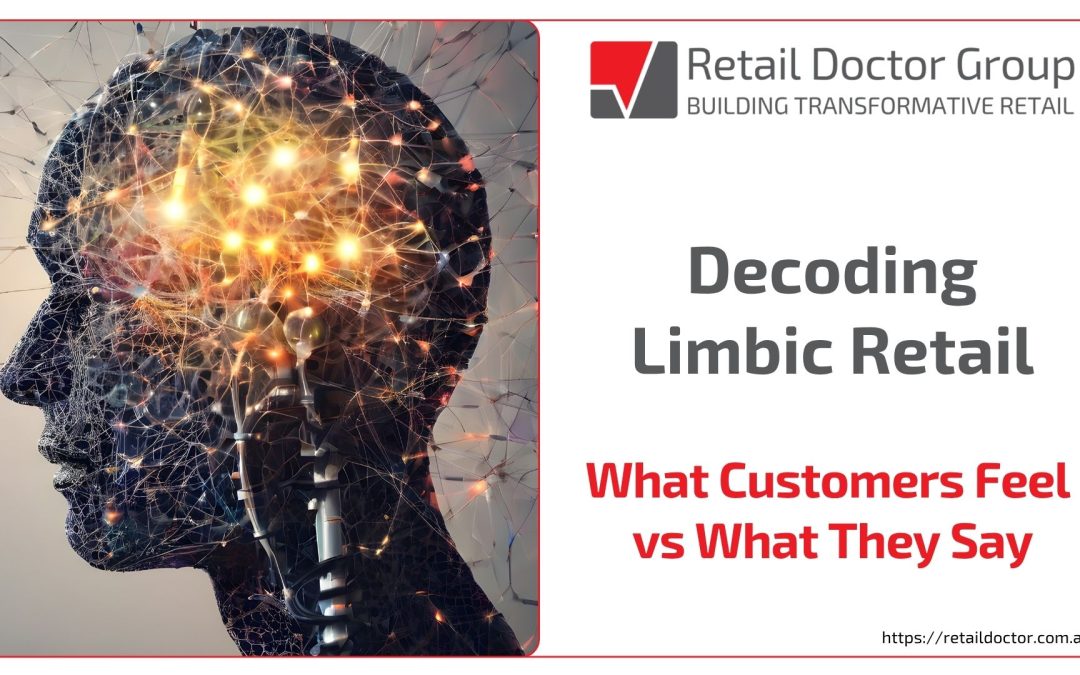
The days of retailers competing against what consumers say are long gone. The commercial reality is that retail has evolved to focus on how consumers feel. By decoding limbic retail and what it means for your business today, you can improve behavioural alignment, reduce cognitive friction, and better understand how consumer decisions are formed beneath conscious awareness.
Retailers only optimising around what customers say increasingly risk misreading what actually drives conversion, loyalty, and revenue quality.
Key Takeaways
- Customer explanation often hides the emotional driver of spend.
- Behavioural signals give leadership a stronger commercial read.
- Loyalty forms through memory, ease, trust, and repetition.
- Cognitive friction weakens conversion before price becomes visible.
- Limbic Insights™ turns customer understanding into performance advantage.
What is Limbic Retail?
Consumers describe themselves as rational, price-conscious, and deliberate. Their behaviour consistently reflects something else entirely: emotion, familiarity, perceived safety, cognitive ease, trust, and subconscious preference.
This gap between stated behaviour and actual behaviour is now commercially decisive.
ESSENTIAL READING
The Gap Between Intent and Spend
Consumers can describe what they bought. They often struggle to identify the drivers that helped them make their purchasing decisions.
A customer may explain a purchase through price, value, range, convenience, or habit. The operating signal often sits deeper:
- Familiarity reduces hesitation.
- Trust lowers perceived risk.
- Emotional memory shortens the path to action.
This distinction is important in disruptive retail because leaders act on what they can measure. A business that reads explanation as motivation will therefore invest behind the wrong lever.
The cost of that miscalculated investment appears in conversion leakage, weaker loyalty economics, heavier promotional dependence, and slower return from customer experience investment.
Decoding limbic retail gives leadership a stronger view of the drivers beneath stated preference, shifting the conversation from customer opinion to commercial behaviour.
Behaviour Gives Leaders the Commercial Read
Retailers already hold signals that show how customers decide. Basket movement, dwell time, abandoned journeys, loyalty usage, repeat purchase, channel switching, and offer response all expose pressure points.
The issue sits in interpretation:
- Data shows action.
- Limbic Insights™ explains why the action occurred and where value may be strengthened.
A customer who returns frequently may feel emotionally settled. Another who compares heavily may lack trust, while those who frequently switch channels may be reducing effort, price anxiety, or delivery uncertainty in the moment.
These distinctions change the executive decision. They guide where to simplify, to reassure, to strengthen loyalty, and critically, where to stop spending behind signals that fail to convert.
Stated Preference Can Weaken Strategic Confidence
Customer research often captures the story after the decision. The buyer wants the purchase to sound rational, so they’ll justify their buy. Their answer reflects logic, even when the driver originated in sentiment and feelings.
That creates risk for leaders close to investment decisions. Experience redesign, loyalty investment, pricing architecture, and AI personalisation all depend on the quality of the customer read.
A weak behavioural read increases the chance of funding activity that looks customer-led and still fails to shift performance. Retailers will see this clearly when satisfaction scores look stable yet switching continues. It’s even more visible when:
- loyalty members remain active and emotional attachment weakens.
- customers say price matters most, then choose the option that feels easier, safer, or more familiar.
The commercial issue here is precision. Investment must land on the behaviour that drives action.
Loyalty Forms Before the Transaction Is Measured
Loyalty appears in metrics after it forms in the customer’s mind.
Repeat purchase, retention, points redemption, and frequency all matter. They measure the result, but don’t always reveal the emotional conditions that created it.
Customers stay with retailers that reduce effort and protect confidence. They return to experiences that feel familiar, consistent, and easy to trust.
Over time, these interactions build memory. The customer begins to choose with less evaluation:
- Preference becomes faster.
- Comparison becomes lighter.
- Revenue becomes more durable.
This changes how leadership should judge loyalty investment. The value sits in the quality of customer attachment, the ease of repeat behaviour, and the margin resilience created when customers feel less need to be re-earned every time.
MUST-HAVE RESOURCE
Decoding Limbic Retail Earns Higher Loyalty ROI
Decoding limbic retail gives leadership a clearer way to read loyalty before it shows up as retention, spend, or churn.
The strongest signals appear in the moments where the customer acts with less effort:
- They come back faster.
- They compare less and accept more recommendations.
- They trust the next step, giving the retailer more of the decision.
Decoding those signals accurately is vital because loyalty investment is expensive. Points, offers, personalisation, service design, and experience improvement need to strengthen attachment, not just stimulate activity.
Cognitive Friction Is a Margin Issue
Every uncertain decision carries cost.
Confusing offers, unclear navigation, inconsistent pricing, excessive choice, fragmented journeys, and weak service signals increase cognitive load. Customers pause, compare, defer, or leave.
That leakage often gets treated as a marketing or experience issue. It flows directly into sales, labour productivity, basket size, channel return, and margin.
The strongest retailers reduce effort at the points where value gets made or lost:
- They make the next action clear.
- They make confidence feel easier.
- They remove doubt before the customer has to justify it.
Decoding limbic retail gives retailers a clearer way to assess friction. The goal is to find where customers lose confidence and where the business pays for that loss.
Evidence and Signal Integration
The behavioural gap becomes most useful when it’s read through observable signals. Limbic Insights™ gives those signals their commercial meaning, connecting what customers do with the emotional and subconscious drivers behind the decision.
Behavioural Signals Already Show the Pressure
AI adds more pressure. Search, recommendations, predictive merchandising, personalised offers, and loyalty prompts now shape customer attention before conscious comparison has fully formed.
The system increasingly influences what the customer sees, considers, trusts, and buys. That changes where loyalty forms and where commercial control sits.
Retailers relying on stated customer feedback will only see part of the picture. Leaders reading behavioural signals with limbic discipline gain a sharper view of where value is being won or lost.
MUST-HAVE RESOURCE
Signals to Pressure-Test
Leadership teams should pressure-test the signals that reveal decision quality:
- Where do customers hesitate before committing?
- Which journeys create repeat behaviour without heavy discounting?
- Which loyalty members show habit without emotional attachment?
- Where do AI-led recommendations increase confidence or add noise?
- Which experiential moments lower comparison and protect margin?
These signals reveal the gap between customer intention and customer action. They also show where the next commercial intervention should sit.
Mystery Shopping strengthens this read by observing behaviour as it happens, giving leaders visible evidence of where confidence builds, where friction appears, and where execution changes the customer decision.
The evidence points to a sharper leadership requirement. Customer understanding must now support investment decisions, operational focus, and value creation with greater precision.
The Value Decision for Retail Leaders
Customer understanding must become more commercially exact.
Retailers making major choices around loyalty, CX, AI, pricing, merchandising, and omnichannel investment need a sharper read on how customers decide before capital, time, and internal focus are committed.
The value at stake sits in conversion quality, margin resilience, customer ownership, and the ability to build loyalty that holds without constant promotion.
Decoding limbic retail gives boards and executive teams a more precise view of customer behaviour. It helps identify where feeling drives action, where friction weakens value, and where execution must shift.
That requires Strategy Alignment: a clear leadership view of where customer behaviour is shifting, which decisions matter first, and how to reduce risk as the business moves from insight to execution.
ESSENTIAL READING
Next Steps for Retailers
The practical work starts with pressure-testing the customer read already inside the business. These actions keep the focus commercial, measurable, and close to the decisions leadership teams are already making.
Executive Actions
Use Strategy Alignment to bring leadership teams, customer teams, operations, merchandising, and CX around the same behavioural read.
Run Mystery Shopping across priority journeys to observe where confidence builds, where friction appears, and where execution changes the customer decision.
Use Limbic Insights™ to decode the resulting emotional and subconscious drivers shaping retention, basket size, margin, and customer value.
Map those findings against actual behaviour, channel movement, loyalty patterns, conversion leakage, and commercial performance.
Sequence the highest-value actions first, with early proof visible through conversion, retention, spend quality, or reduced friction.
This creates cohesion and builds internal buy-in, reducing risk and minimising aversion to change.
Convert customer understanding into decisions and measurable value across every touchpoint. Download the Limbic Insights™ brochure now.
Let’s Talk
Book a Consumer Behaviour Decoding Session with RDG’s Limbic Insights™ team, headed by Josh Strutt, to understand what your customers are doing, why they’re doing it, and where value is being won or lost.
Authored by: