
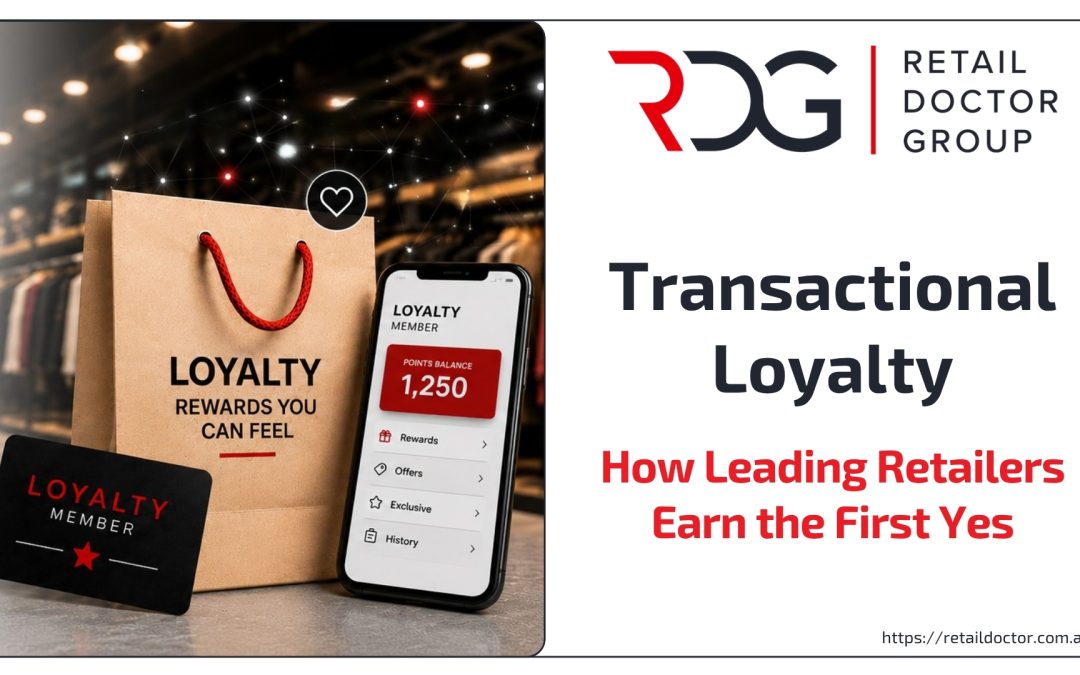
Transactional loyalty earns the first yes.
It gives consumers a clear reason to engage, test the value exchange, join the program, return to the retailer, and decide whether the relationship is worth continuing.
That makes transactional loyalty foundational to resilient consumer loyalty, but its commercial value depends on how well it’s designed to move consumers forward.
Key Insights
- Transactional loyalty is where consumer loyalty begins, and it only earns its place when the value is instantly clear.
- A weak value exchange buys attention through ever-richer rewards. A credible one buys it once.
- Strong programs make the exchange simple, fair, and worth repeating, never just the next discount.
- The job of transactional loyalty is to remove friction and make the next visit the obvious move.
- Get the base layer right, and it becomes the foundation behavioural and emotional loyalty are built on.
What is Transactional Loyalty?
Part 1 in this series introduced the commercial risk of rented loyalty and the shift retailers need to make from program participation to preferred choice.
The foundation of that loyalty hierarchy is transactional loyalty. It’s where the consumer first sees the exchange, where the program proves whether the exchange holds up, the effort is reasonable, the reward is useful, and the retailer is worth another visit.
That distinction has a cost attached. Retailers with a shaky exchange end up funding loyalty twice: once to win the sign-up, then again every time a competitor’s offer looks better, through deeper discounts and richer perks. Retailers that get the exchange right pay once, because the program has already proven it’s worth trusting.
For retail leaders, that first exchange sets the tone for everything that follows:
- Understanding the value is more likely to lead to participation.
- Accessible value is more likely to be used.
- Seeing the value exchange as reliable and repeatable encourages habit and behavioural change.
Handled well, that first exchange stops being a transaction and starts being proof the retailer can be trusted with more.
PART 1: Turning Rented Loyalty Into Preferred Choice
The Hierarchy of Resilient Loyalty
In Part 1, we determined that loyalty works across three connected layers:
- Transactional loyalty creates participation.
- Behavioural loyalty creates routine.
- Emotional loyalty creates preference.
Each level builds on the one below it. A clear value exchange gives consumers a reason to keep engaging, an easy program helps routine form, and strong basics give emotional loyalty more opportunity to develop.
This layer is the first proof point. The next task is to convert that participation into behaviour, then preference, then resilience.
Building the hierarchy is commercially important because it keeps two disciplines clear:
- This layer has commercial value because it creates entry, proof, and program momentum.
- It has to feed a wider strategy, too, because points, discounts, and offers carry more value when they connect to brand strength, experience quality, and emotional relevance.
Transactional loyalty is therefore necessary, useful, and commercially valuable when it’s designed as the foundation for something deeper.
Transactional Loyalty Has To Be A Better Value Exchange
Clarity of offer is one of the strongest indicators of effective transactional loyalty, and strong programs start with a simple commercial discipline: make the value exchange obvious.
Consumers should know what they get, how they earn it, how they use it, and why it’s worth their attention. That sounds simple, but many programs lose strength because the value is too slow, too hidden, too conditional, or too detached from how consumers actually shop.
The value exchange works when it feels visible and fair.
That value can come through points, discounts, offers, member pricing, delivery benefits, early access, everyday convenience, or a more useful shopping experience. The mechanic matters, but the clarity matters more.
Consumers need the program to feel consistently worthwhile:
- A weaker value exchange keeps the retailer buying attention through heavily discounted offers, richer rewards, or more aggressive promotions.
- A stronger value exchange creates the sense that the consumer is better off inside the relationship than outside it.
That’s the commercial role of this layer. It helps consumers feel the program is worth using, while giving them a reason to come back that has nothing to do with the next markdown.
RELATED CONTENT: Why Customers Buy
From Discount Dependence To Credible Value
Retailers often treat transactional loyalty as a promotional lever, which makes it effective in the short term but expensive over time.
The stronger approach is to make this layer credible enough to encourage repeat behaviour while protecting margin across repeated interactions.
Credible value can be built in several ways. Rewards can be easier to earn. Benefits can be clearer. Redemption can be faster. Member pricing can feel meaningful while supporting the wider reason to buy.
Convenience can remove effort. Service recovery can protect confidence. Program communication can show progress, savings, and next-best value without overwhelming the consumer.
The goal is to make the value exchange feel active, useful, and dependable. When a loyalty program delivers this well, the consumer starts to build trust in the system:
- They know the program works.
- They understand the benefit.
- Visible progress and recognition give them a reason to return.
That’s the point where this foundation layer begins to support behaviour.
Transactional Loyalty Should Encourage The Next Visit
The foundation of loyalty should always point somewhere.
The transactional layer should encourage the next visit, scan, redemption, basket build, or category interaction. It should make the next step feel natural, low-effort, and worth taking.
This works best when the program operates as a practical shopping tool, with the reward ledger supporting the experience.
A well-designed transactional layer helps consumers form a repeatable pattern. It reduces the effort required to remember, access, or use the program. It makes benefits available at moments that matter, and links value to the shopper’s existing behaviour, rather than asking them to work around the program.
Retailers can create more value without increasing reward cost by making the program easier to use. The app can be more helpful in-store. The offer can arrive closer to the decision.
The reward can be connected to a known shopping mission. The communication can show exactly what was earned, saved, or unlocked. The member experience can feel cleaner, faster, and more relevant.
Each improvement strengthens the first layer of loyalty. Repeated use creates the behavioural signals retailers need to build the next layer.
RELATED CONTENT: Using Behavioural Intelligence to Eliminate Friction
Building From Value To Preference
The pathway from transactional to resilient loyalty begins with value, and its commercial strength grows when that value leads into preference.
RDG’s Limbic Insights™ helps retailers understand which emotional reasons matter most to priority consumers. The same transactional mechanic can carry different emotional meaning depending on the consumer mindset.
- Ambitious Achievers prefer tiers and milestones that help them level up.
- Data Dynamos need to know exactly what they earned and saved per transaction.
- Experience Evangelists like being surprised by early access.
- Family Followers must be reassured that their household spend is safe.
- Logical Loyalists run on predictability and stable execution.
- Open Minded consumers want the freedom to choose a range of benefits that suits them best.
Transactional loyalty is clearly about more than just making a deal. When the retailer understands what the mechanic needs to mean to each consumer segment, the value exchange can support a stronger reason to choose.
Where Limbic Insights™ Unlocks The Next Step
Transactional loyalty begins with practical value, and consumers still interpret that value emotionally.
RDG’s Limbic Insights™ makes the transactional layer more commercially decisive because it shows which emotional meaning the value exchange must carry for priority consumers to recognise it, trust it, and repeat it.
A stronger program frames value around the consumer’s decision driver, not just the program mechanic. That means the same benefit can be shaped as proof, progress, care, control, recognition, discovery, or reliability, depending on the consumer mindset the retailer needs to win.
That turns transactional loyalty into a sharper route to resilient loyalty. It helps retailers replace generic offers with value exchanges that feel personally relevant, commercially credible, and easier to repeat.
ESSENTIAL DOWNLOAD: Why We Buy Whitepaper
From Useful To Repeatable
The foundation is working when the consumer’s first useful interaction becomes a repeatable behaviour, giving the retailer a chance to build a stronger reason to return. Over time, this can become behavioural loyalty, where convenience, habit, frequency, and ease make the retailer part of the consumer’s routine.
The next layer has to be earned through the quality of that repeated experience.
Transactional loyalty opens the door, behavioural loyalty keeps the consumer moving through it, and emotional loyalty gives them a reason to choose the same door when another one opens beside it.
Transactional loyalty should therefore be treated as a strategic foundation, with discounts serving the value exchange inside a wider route to repeat behaviour.
Next Steps for Retail Leaders
Getting transactional loyalty right isn’t a program tweak, it’s a foundational decision that determines whether every dollar spent on rewards builds something durable or just rents attention one promotion at a time.
Retail leaders should start by auditing their current value exchange against a single question: is it instantly clear, or does it rely on the consumer working it out? Where the answer is unclear, that’s the cost showing up before the competitor’s offer ever does.
From there, the priority is sequencing, not scale. Fix clarity and friction in the transactional layer before investing further in richer rewards or emotional campaigns, because neither will hold if the base layer hasn’t earned trust yet.
This is where the difficulty compounds. Knowing the exchange needs to be clearer is one thing, knowing which mechanic, message, and moment will make it feel clear to a Data Dynamo versus an Experience Evangelist is another.
That’s the judgement RDG’s Limbic Insights™ exists to sharpen, turning a generic fix into a decision retail leaders can act on with commercial confidence.
ICYMI | EXECUTIVE WEBINAR: Paradox of Consumer Loyalty
Next In The Series
Part 1 named the risk sitting inside rented loyalty, and the shift from program participation to preferred choice every retailer now has to make.
Part 3 picks up from here, examining behavioural loyalty, and how convenience, routine, and reduced friction turn a first exchange into a habit.
👉🏻 Subscribe now to be notified when Part 3 publishes.
Download The Paradox of Consumer Loyalty Executive Brief to understand how RDG’s loyalty hierarchy and Limbic Insights™ help retailers turn transactional participation into repeat behaviour, preferred choice, and resilient consumer loyalty.
Speak to a Limbic Insights™ retail expert today. Contact the team for your complimentary consult now.
☎ +61 2 9460 2882
✉ businessfitness@retaildoctor.com.au
🌐 retaildoctor.com.au
Authored by